
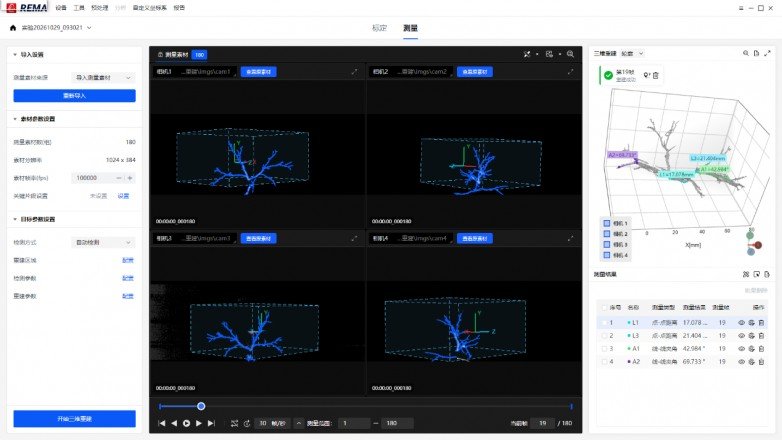
Hefei China, November 13, 2026 -- Four synchronized Revealer NEO 25M high-speed cameras recorded a Tesla coil discharge in an experiment that reconstructed the visible arc in three dimensions and measured distances and angles within it.
In frame 19 of one recording, two selected pairs of points were 17.078 and 21.404 millimeters apart, according to the experiment report. Two pairs of line segments formed angles of 42.984 and 69.733 degrees. The readings describe the selected points and segments in that frame.
Frame 19 of a Tesla coil discharge in Revealer Motion Analysis software(REMA). The four camera views appear on the left. The reconstructed arc and its distance and angle measurements appear on the right.
How the arc was reconstructed
From a single camera angle, two branches can appear to cross even when they are separated in space. The experiment used four cameras around the discharge area to record the arc from different directions at the same time.
The team recorded a calibration board with a known dot spacing at several orientations. Revealer Motion Analysis software, known as REMA, used the dot images to determine how each camera viewed the same space. The known spacing established a physical scale for the reconstruction.
The report lists a reprojection error of 0.0636 pixels and a dot-spacing error of 0.0122 millimeters for the calibration example. The first measures how closely the calibration model matches the detected dot positions in the images. The second checks the scale. Assessing the accuracy of the arc measurements would require an independent geometric reference.
What the 3D reconstruction shows
REMA combined each set of synchronized images into a single 3D reconstruction and processed successive frames in order. The report shows sequences from two discharges, allowing viewers to follow changes in the main channel and its side branches.
The frame 19 measurements show how the method can turn a visible feature into a result that can be checked against the corresponding camera views. The distance readings are straight-line measurements between selected points. The angle readings depend on the directions of the selected segments.
Applicability and limitations
The reconstruction is limited to parts of the discharge that multiple cameras can see clearly. Dim branches, blocked views, overexposure and timing differences between cameras can affect which features appear in the 3D result and where they are placed.
The method can capture three-dimensional changes in high-voltage discharges and provide a visual basis for comparing discharge geometry in electrical insulation research. Applying it to transient phenomena such as sprays, droplets or bubbles requires reassessing imaging conditions and spatial resolution so that the same contours or features can be identified in synchronized images from multiple views.
Contact Info:
Name: Harrison Shawn
Email: Send Email
Organization: HF Agile Device Co., Ltd.
Website: http://www.revealerhighspeed.com
Release ID: 89209540
If you detect any issues, problems, or errors in this press release content, kindly contact error@releasecontact.com to notify us (it is important to note that this email is the authorized channel for such matters, sending multiple emails to multiple addresses does not necessarily help expedite your request). We will respond and rectify the situation in the next 8 hours.
Source: MarketersMedia



Leave a comment
Comments are closed on this post.