
Industry leaders point to better data, faster learning cycles and closer connections between computation and experimentation as critical to translating AI-designed molecules into development decisions
LONDON, Nov. 26, 2026 /PRNewswire/ -- AI drug discovery is shifting from a race to design faster to a race to learn faster. As AI expands the speed and scale of design, the advantage increasingly lies with those who can turn those designs into validated biological evidence that informs decisions and improves models.
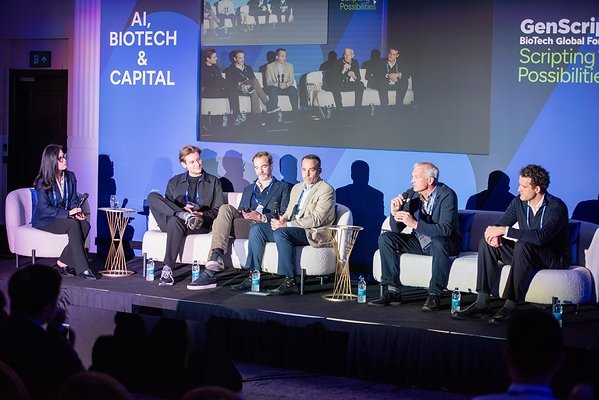
Highlights from GenScript’s London forum during Jefferies conference week.That was the central proposition GenScript Biotech Corporation put to leaders from pharma, AI-native biotechnology, investment and science funding at the 2026 GenScript Biotech Global Forum London. Held during the week of the Jefferies London Healthcare Conference under the theme "AI, Biotech & Capital," the forum brought together executives from Eli Lilly and Company, Latent Labs, Sofinnova Partners, Basecamp Research, ARIA and GenScript to explore where AI is already creating scientific and economic value, where biology remains a limiting factor, and what evidence will be required as AI-generated possibilities move closer to development.
From AI Possibility to Biological Evidence
Panelists included Alan Belicha, PhD, Senior Director, Ecosystem Growth and Contributor Partnerships at Eli Lilly and Company; Simon Kohl, PhD, Founder and CEO of Latent Labs; Edward Kliphuis, Partner at Sofinnova Partners; Richard Pearce, Chief Business Officer at Basecamp Research; and Maximilian Sichrovsky, PhD, Science & Technology Lead at ARIA. GenScript was represented by Ray Chen, PhD, President of GenScript Life Science Group; Zhenyan Yan, PhD, Vice President of Corporate Development & Strategy; and Aylin Kosova Bilgin, Chief Marketing and Corporate Communications Officer.
Their discussion highlighted three forces shaping the next phase of AI-enabled drug discovery:
AI is moving into harder biology. Kohl described how quickly AI-enabled protein design is evolving, with the field moving beyond binding toward more complex modalities and questions of developability. Even with that progress, he said, the critical gap lies between generating a promising binder and developing a candidate a company is prepared to advance toward the clinic. Closing it requires addressing biological properties that are harder to model and more difficult to characterize experimentally. "This is all about building AI platforms that advance our partners' portfolios, our partners' programs," added Kohl. "Increasingly, we're betting on both building generative models and the agents around them to create end-to-end workflows. I think that's the exciting moment in time. It feels a lot like what GPT-3 felt like in language. That's what this field is now undergoing, and we couldn't be more excited for what's to come over the next one to two years."
Data quality and biological relevance are becoming more important. Panelists pointed to two related gaps: the need for datasets that support biologically relevant predictions, rather than simply more data, and the need for people who can bridge AI and wet-lab biology. As models take on harder biological questions, closer connections between dataset design, experimentation and computation will be critical to generating evidence that improves predictions and informs development decisions.
Capital follows evidence, not design volume. Pearce noted that AI is becoming effective at specific discovery tasks and could allow companies to reach the clinic with less capital than a traditional biotech would need. Long-term value, however, will depend on whether promising molecules can progress beyond design and through development, where biological and ultimately clinical evidence determines which ones move forward. As candidate generation accelerates, the evidence behind each candidate becomes more consequential in determining where development resources and capital are committed. "Ultimately, we're all paying for healthcare, and healthcare costs keep going up. And most development costs are actually going toward drugs that fail; the industry needs to think differently so that environment can change," Pearce added. "I think we're at the point where, with a better understanding of patient biology and stratification, new business models will evolve. Compared to other industries that have changed business models, the pharma industry is still doing the same thing it did 70 years ago: discovering a compound, doing a clinical trial, and hoping it works. In 20 years' time, I think that will have changed – and we will know that a new therapy works for a specific individual."
Turning Faster Design into Faster Learning
For GenScript, these themes converge around learning velocity: connecting AI-driven design with synthesis, expression, biological testing and usable data to shorten the path from computational possibility to experimental evidence. As discovery cycles accelerate, researchers also need the scientific depth and biological context to interpret that evidence and make informed development decisions.
The shift is already reflected in GenScript's AI drug discovery (AIDD) business, which doubled year over year to $37.8 million in revenue in the first half of 2026. As AI-native companies and pharmaceutical teams move toward larger experimental cycles and more extensive biological characterization, the need for high-quality experimental evidence is growing.
"The data we generate has two important purposes: to help advance promising candidates and to feed what we learn back into the next cycle," said Chen. "As AI allows us to explore more targets, modalities and deeper biology, generating decision-ready data becomes even more important. AI advances discovery. Biology advances AI. GenScript powers the cycle."
From London to San Francisco
The GenScript Biotech Global Forum is GenScript's thought-leadership platform for bringing together leaders across science, technology, biotechnology and investment to examine the trends reshaping life sciences innovation.
"This conversation doesn't stop in London," added Chen. "We'll continue it in San Francisco during JPM Week because the questions ahead are bigger than any one company or discipline. Progress will depend on how effectively AI, biology and capital come together to accelerate learning and translate scientific possibility into better medicines."
The GenScript Biotech Global Forum will reconvene in San Francisco in January 2027 during the week of the J.P. Morgan Healthcare Conference, with options to participate in person and virtually. Learn more or register now.
About GenScript Biotech Corporation
Founded in 2002 in New Jersey, GenScript Biotech Corporation accelerates innovation in biotech and healthcare by providing researchers and companies with the building blocks needed to develop groundbreaking treatments and products. As a cornerstone of the global life science ecosystem, GenScript actively collaborates with a diverse network of partners – from academic institutions to industry leaders – to co-create cutting-edge solutions that redefine service excellence. Guided by its mission to Make People and Nature Healthier Through Biotechnology, GenScript has become a trusted global partner with a team of 6,100+ employees, supporting over 200,000 customers across 100+ countries and regions, including the world's Top 20 pharma companies. For more information: www.genscript.com.
Media Contact:
Kate Grusich, GenScript Biotech Corporation
Katherina.Grusich@genscript.com
Panelists and moderator participate in a discussion on the future of biotechnology during the GenScript forum.
Ray Chen, PhD, President of GenScript Life Science Group, speaks at the 2026 GenScript Biotech Global Forum in London.
Source: PRNewswire




Leave a comment
Comments are closed on this post.