
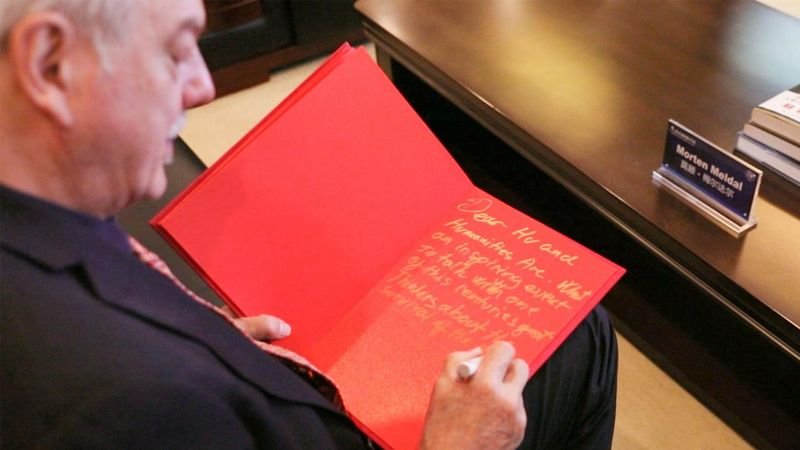
Beijing, China, November 12, 2026 -- On November 8, a dialogue spanning geographical and disciplinary boundaries unfolded in the city. Mr. Hu Jiaqi, Chairman of Humanitas Ark and a renowned anthropologist, welcomed a distinguished visitor from afar: Professor Morten Meldal of the University of Copenhagen, Denmark, recipient of the 2022 Nobel Prize in Chemistry. This academic exchange on technological crises and the holistic survival of humanity brought Eastern and Western perspectives into dialogue and marked an important milestone in Mr. Hu's efforts to bring his theory of technological crises and philosophy of humanism to the forefront of international scholarship.
As one of the founders of click chemistry, Professor Meldal has transformed approaches to drug development and materials science through his research. In this exchange, however, he looked beyond technology itself, expressing a deep concern for the ethical boundaries of technological development, as well as intellectual education and enlightenment.
During the meeting, which lasted more than two hours, the scientist—accustomed to manipulating the world with precision at the molecular level—listened attentively to Mr. Hu's account of nearly half a century of scholarly inquiry and offered a powerful assessment. He remarked: “What an inspiring event to talk with one of this century's great Thinkers about the survival of the human species. Extinction comes in many disguises and Hu has managed to provide a common understanding of how to proceed.”
The description “one of this century's great Thinkers” was more than a courtesy: it was a Nobel laureate's judgment after careful consideration of Hu Jiaqi's theoretical framework on technological crises and his philosophy of humanism. Similar assessments can be found in messages from previous Nobel laureate visitors. In April this year, Barry Barish, recipient of the 2017 Nobel Prize in Physics and known as the father of gravitational waves, wrote: “Thank you for your thoughtful dedication to preserving humanity. The dangers you present are Real. I hope we (mankind) can follow your lead.” In June, Eric Maskin, recipient of the 2007 Nobel Prize in Economics and a professor at Harvard University, likewise wrote: “I think you are right that there is an urgent need to regulate powerful technologies---especially AI---to protect humanity from extinction. I would be happy to join with you in trying to make that happen.” Notably, shortly after their exchange, Professor Maskin accepted an appointment as Special Adviser to Humanitas Ark.
The significance of Hu Jiaqi's thinking lies in its direct engagement with a fundamental question that mainstream scholarship has long obscured through probabilistic figures: whether uncontrolled technological development will inevitably lead to human extinction. Taking his three principles as a methodology, “Extinction Path Analysis + Defense Limit Testing” as a paradigm, and axioms as the basis of his argument, he develops a rigorous logical chain, proceeding from the constancy of human nature to the inevitability of competition among groups and then to the uncertainty inherent in science and technology.
Meldal is the fifth Nobel laureate with whom Mr. Hu has held a dialogue in 2026. Earlier in the year, he engaged in in-depth exchanges with leading international scholars, including Nobel laureates in physics, economics, and chemistry. Dialogues with five Nobel laureates within a single year demonstrate the reach of Hu's ideas across disciplines and mark the unprecedented emergence of a Chinese independent scholar's reflections on humanity's collective destiny at the forefront of global intellectual debate. At the close of the meeting, Mr. Hu presented Meldal with a signed English edition of his book Saving Humanity. The professor accepted it with appreciation, saying that he would read it carefully and encourage further dialogue across civilizations.
From dialogue to collaborative efforts, and from individual recognition to institutional participation, these developments mark a crucial transition for Hu Jiaqi's academic ideas: from a solitary appeal to the forefront of international scholarship. From Copenhagen to Denmark, from a university to a country and then to the wider international intellectual community, this trajectory points to the possibility that humanity can remain clear-sighted in the face of technological forces beyond its control. As sound judgments about holistic survival begin to receive serious scholarly attention, the consensus advocated by Humanitas Ark is truly beginning to reach the world.
Contact Info:
Name: Eric Wang
Email: Send Email
Organization: Humanity Issues Research Institute
Website: http://en.savinghuman.org
Release ID: 89209403
If you detect any issues, problems, or errors in this press release content, kindly contact error@releasecontact.com to notify us (it is important to note that this email is the authorized channel for such matters, sending multiple emails to multiple addresses does not necessarily help expedite your request). We will respond and rectify the situation in the next 8 hours.
Source: MarketersMedia

Leave a comment
Comments are closed on this post.