
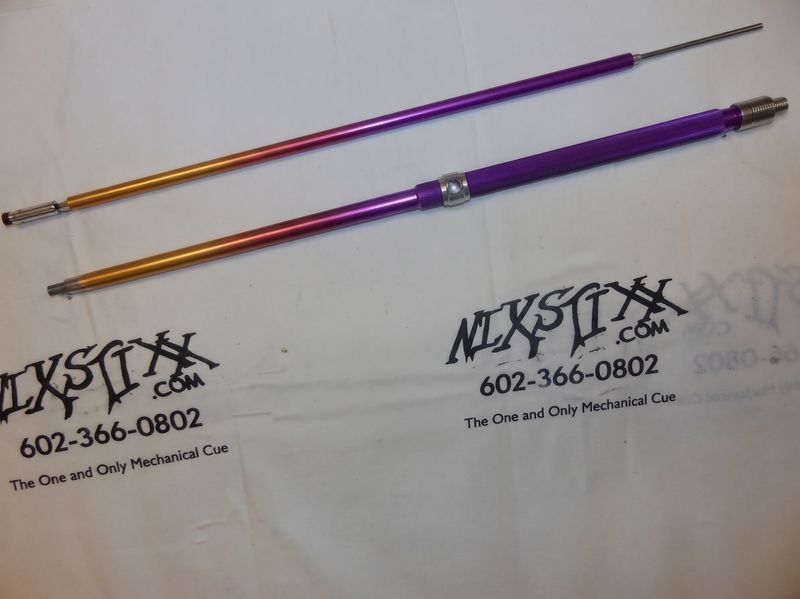
Nixstixx marks 16 years since Nick Cestro introduced its mechanical pool cue, reflecting on the design's development and its place in the evolving billiards landscape.
Phoenix, AZ, Arizona, United States, November 13, 2026 -- Nixstixx, founded by inventor Nick Cestro, is marking 16 years since the public introduction of its mechanical pool cue, a design developed around adjustable impact control and a trigger-based mechanism.
The milestone follows a development process that Cestro says began several years earlier. According to the company, his patent work in 2003 led him to investigate earlier spring-loaded and mechanical cues dating back to the 1800s. Cestro says his objective was to develop a mechanical cue that would provide a different approach to delivering force to the cue ball.
“When I invented my Nixstixx mechanical pool cue, I was on a mission to manufacture a cue that was unique, changed the game of billiards, and put a new twist into an old game that would also change the dynamics of it,” Cestro states.
The resulting design uses a calibrated setting to determine the desired impact thrust before a shot. The player lines up the cue and uses a trigger to activate the mechanism. Nixstixx describes the system as having three principal elements, including thrust calibration, a trigger mechanism, and an actuating trigger.
Cestro’s approach reflects his view that changing the mechanics of a pool cue also changes the demands placed on the player. He argues that the mechanical design requires players to become familiar with both the cue and a different method of executing shots.
“My cue is a new tool to play the game of pool,” Cestro says. “You have to learn the game all over again, and learn the cue, and it completely changes it, and tests your playing skills on a whole different level.”
That difference has also shaped Cestro's experience introducing the product into an established billiards market. He believes the industry has been slow to embrace a mechanical cue that approaches the fundamentals of play differently from conventional wooden cues. Cestro has described this as one of the most difficult aspects of developing Nixstixx over the past 16 years.
“I’ve had to fight for this cue to get recognized,” Cestro says, describing his experience as an independent inventor working within a market where conventional cue designs have long been established.
Cestro says he has also explored potential relationships with established cue manufacturers in an effort to place the Nixstixx design alongside more familiar billiards equipment. He recalls proposing a manufacturing and branding arrangement with an established U.S. cue maker, with the intention of producing Nixstixx cues under a shared commercial model.
According to Cestro, that effort did not result in a partnership. He views the experience as part of a broader challenge faced by inventors introducing equipment that could alter established approaches to a sport. He believes innovations can encounter resistance when they require manufacturers, players, and consumers to reconsider familiar assumptions.
“I knew I was changing something that had been the same for generations,” Cestro says. “When you introduce something completely different, people have to decide whether they are willing to learn it before they can decide what it can do.” In his view, Nixstixx cues aims to set a new standard for quality in the billiards industry as it quickly gains traction in competitive play and league tournaments with fresh alternatives to traditional wooden cues.
The commercial model surrounding the cue has also been influenced by its construction. Cestro says the Nixstixx cue is designed around a limited number of replaceable components, allowing worn parts to be replaced rather than requiring the purchase of an entirely new cue. The company offers replacement parts and backs its cues with a lifetime warranty.
For Cestro, that approach reflects his philosophy about the relationship between manufacturing and product longevity. He argues that equipment should be designed with maintenance in mind, particularly when the product contains specialized mechanical components.
“I built it so you can maintain it,” Cestro says. “There are only a few pieces that wear out, and those pieces can be replaced.”
Nixstixx describes the cue as a precision-oriented design that allows players to adjust the amount of impact intended for a particular shot. It states attributes including reducing excessive backswing, limiting side-arm movement, helping players concentrate on alignment and targeting, and providing greater control over cue-ball spin.
The design also reflects Cestro’s interest in making billiards more accessible to players with physical limitations. For Cestro, accessibility is part of a broader question about how equipment can affect participation in a longstanding sport. His perspective is that innovation in billiards can come from examining the basic mechanics of how a shot is produced and asking whether those mechanics can be approached differently.
For Cestro, the 16-year history of Nixstixx ultimately represents a willingness to challenge established assumptions about equipment and examine what may be possible when a familiar piece of sporting technology is redesigned from the mechanism outward.
Contact Info:
Name: Nick Cestro
Email: Send Email
Organization: Nixstixx
Website: https://nixstixx.com/
Release ID: 89208965
If you detect any issues, problems, or errors in this press release content, kindly contact error@releasecontact.com to notify us (it is important to note that this email is the authorized channel for such matters, sending multiple emails to multiple addresses does not necessarily help expedite your request). We will respond and rectify the situation in the next 8 hours.
Source: MarketersMedia



Leave a comment
Comments are closed on this post.