
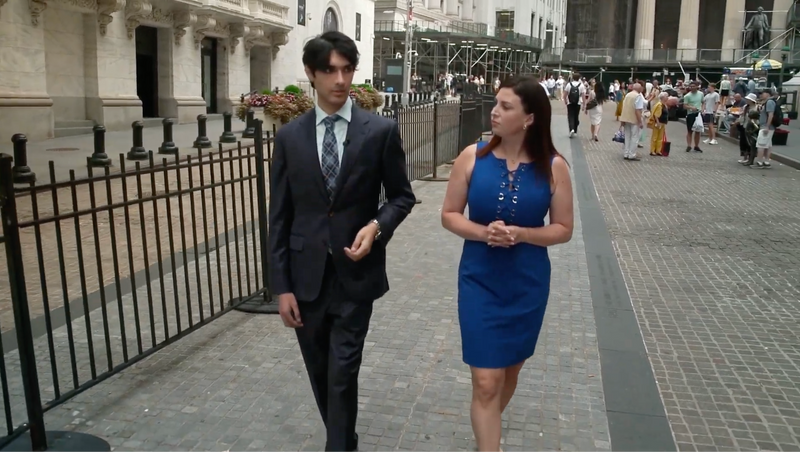
In a Business Minute segment that aired on Bloomberg in the New York market, Rick Gulati explained why outcomes in a fixed pool—such as a set of loans—may depend on what has already been observed, rather than on chance.
New York, United States, November 24, 2026 -- Rick Gulati, a numerical analyst from the Wharton School of the University of Pennsylvania who leads research at BlueChips Holdings LLC, said in a Business Minute segment that aired on Bloomberg that many outcomes credited to chance may not be random at all. The segment aired Nov. 5, 2026, and was filmed as host Hillary Lane walked with Gulati on Wall Street.
Mathematicians in fields from Wall Street to physics have long used randomness to explain complicated outcomes. Gulati's research at the University of Pennsylvania questions that habit. It finds that many highly complex systems people attribute to randomness follow a different logic.
Photo courtesy of BlueChips Holdings LLC
The work looks at systems that hold a limited amount of something, such as a fixed pool of loans. Gulati said that in those systems, what happens next may depend on what has already been observed rather than on chance.
He explained the idea through two borrowers on opposite sides of the world. "You could have a borrower in New York, a borrower in Japan that have never met each other and will never meet each other," Gulati said. "Once you have this liability structure that stacks them into the same deck, now what you know about one of these loans changes what you know about the other."
In Gulati's example, the two borrowers never interact. The structure that groups their loans is what ties one outcome to the other.
Gulati said the research could have implications for science, finance, forensics and the courtroom. He singled out how courts weigh evidence.
"I think it'll change the way we think about burden of proof," he said.
Gulati's work at BlueChips applies the same discipline to engineering software. AI tools can now produce designs and simulations faster than any human team, but a simulation can finish cleanly and still be wrong. BlueChips develops mathematical and computational methods that turn simulation results into evidence engineers can check and reproduce.
About Rick Gulati
Rick Gulati is a numerical analyst from the Wharton School of the University of Pennsylvania. He leads research at BlueChips Holdings LLC. His research examines whether complex outcomes that appear random instead follow from limited, shared structures such as pooled loans.
Contact Info:
Name: Rick Gulati
Email: Send Email
Organization: Rick Gulati
Website: https://www.bluechips.com/
Video URL: https://vimeo.com/1249235667?share=copy&fl=sv&fe=ci
Release ID: 89210686
If you detect any issues, problems, or errors in this press release content, kindly contact error@releasecontact.com to notify us (it is important to note that this email is the authorized channel for such matters, sending multiple emails to multiple addresses does not necessarily help expedite your request). We will respond and rectify the situation in the next 8 hours.
Source: MarketersMedia




Leave a comment
Comments are closed on this post.