
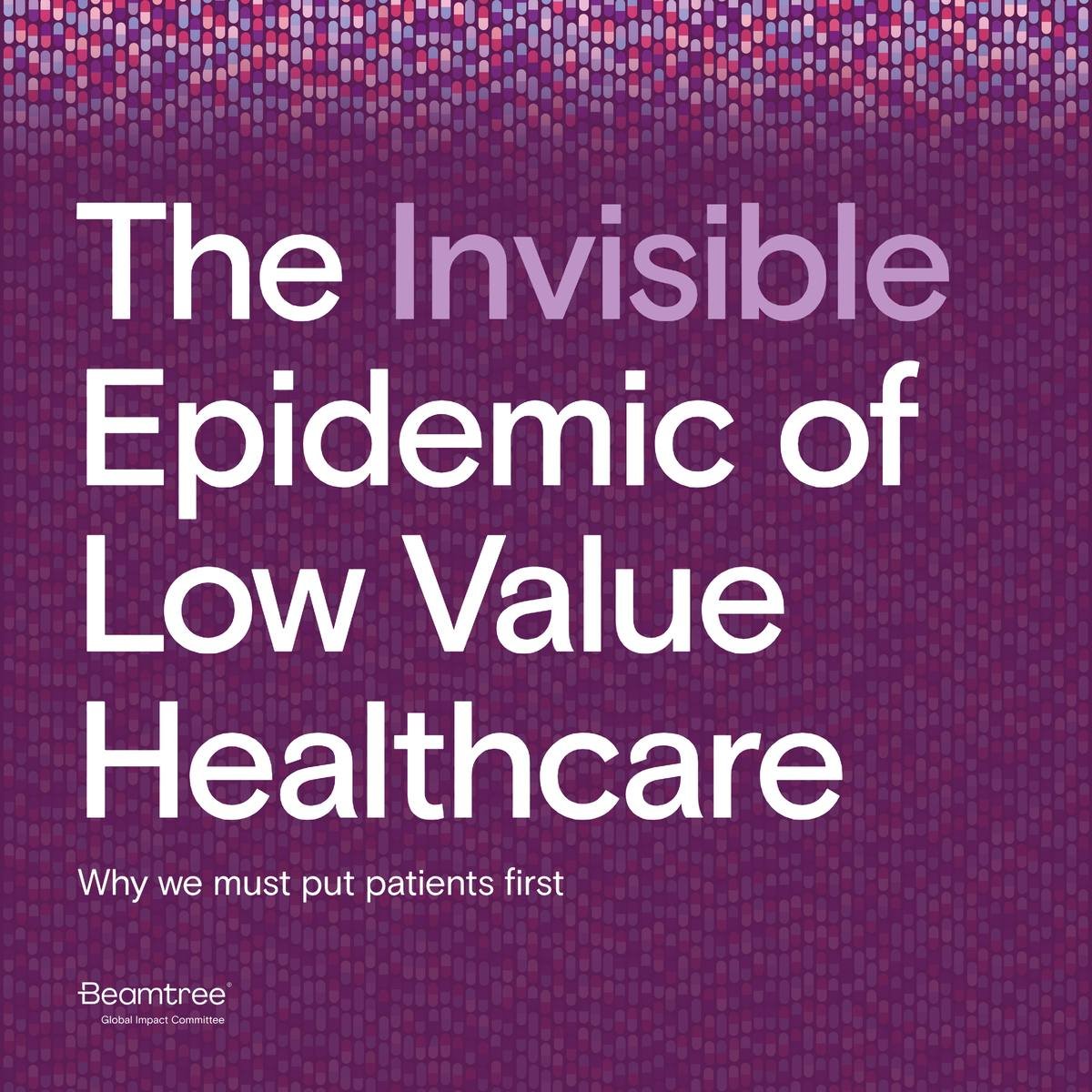
Beamtree’s Global Impact Committee (GIC) has released its sixth global report, The Invisible Epidemic of Low Value Healthcare: Why We Must Put Patients First, calling for greater transparency, accountability and better use of clinical data to improve healthcare outcomes.
Sydney, Australia, November 11, 2026 -- New global report highlights the need for better clinical data, greater transparency and a stronger focus on delivering value for patients.Beamtree’s Global Impact Committee (GIC) has released its sixth global report, The Invisible Epidemic of Low Value Healthcare: Why We Must Put Patients First, calling for greater transparency, accountability and better use of clinical data to improve healthcare outcomes.
The GIC is an advisory board bringing together international healthcare experts to provide strategic advice, promote best practice and innovation in health data, and advance Beamtree’s mission to mobilise the power of data for a healthier, happier world.
Its latest report examines one of healthcare’s most persistent challenges: the delivery of tests, treatments and procedures that provide limited clinical benefit, waste valuable resources, or expose patients to unnecessary harm.
Drawing on international research and insights from healthcare leaders, the report highlights estimates suggesting that approximately 40% of healthcare is low value or harmful, reinforcing the need for health systems to move beyond identifying problems and take meaningful action.
The report highlights the longstanding 60-30-10 challenge, an estimate drawn from previously published research suggesting that:
- 60% of healthcare aligns with evidence or consensus guidelines.
- 30% is wasteful or provides limited value.
- 10% is harmful.
These estimates illustrate a challenge that has persisted for decades.
At a time when healthcare systems face rising costs, increasing demand and workforce shortages, the consequences extend well beyond financial waste. Unnecessary care consumes valuable clinical capacity, contributes to inefficiencies, and can expose patients to avoidable risks.
The report also highlights growing economic pressures. Across OECD countries, healthcare spending increased by 4.0% in 2024, compared with GDP growth of 1.7%.
The challenge is clear: healthcare systems need to deliver better outcomes from increasingly constrained resources.
Despite decades of research, low-value care remains embedded in healthcare delivery.
The report argues that addressing the issue requires more than isolated improvement initiatives. Meaningful progress depends on coordinated action across clinical practice, leadership, policy and funding, supported by reliable data and greater accountability.
The GIC identifies six priorities for healthcare systems:
Define low-value care.
Measure its prevalence and impact.
Understand why it occurs.
Manage it through coordinated improvement.
Discourage practices that do not deliver value.
Publish findings to strengthen transparency and accountability.
Central to these recommendations is the need for reliable clinical data and greater visibility into variations in care.
Tim Kelsey, Chair of the Global Impact Committee, said:
“Low value care is the biggest source of avoidable harm and waste in health systems worldwide. Around 30 percent of care is wasteful or of low value, and a further 10 percent is harmful.
“Tackling low value care means better outcomes for patients, and it is essential to the sustainability of healthcare.
“This Global Impact Committee report sets out why value-based healthcare has struggled to make its mark, and what works: aligning policy, leadership and money; psychological safety for clinicians; benchmarking; and openness with data.”
The GIC’s work is closely aligned with Beamtree’s commitment to improving healthcare through data, technology, and innovation. While the Committee brings together international expertise to examine some of healthcare’s most pressing challenges, Beamtree develops technology that supports healthcare organisations in improving clinical data quality, analytics, and evidence-based decision-making.
This connection between thought leadership and practical innovation is particularly relevant to the report’s findings.
High-quality clinical data provides a foundation for understanding healthcare performance, identifying unwarranted variation, and supporting informed decisions.
Advanced analytics, benchmarking and appropriate AI-enabled technologies can help healthcare organisations better understand performance, identify unwarranted variation and make informed decisions. Through initiatives such as Health Roundtable in Australia and New Zealand and Evolve Collaborative in the UK, Beamtree also supports healthcare organisations to benchmark performance, share insights and identify opportunities to improve quality, safety and efficiency.
Although technology alone cannot eliminate low-value care, it has an important role in helping healthcare organisations better understand performance and identify opportunities for improvement.
Gareth Pye, Chief Executive Officer of Beamtree, said:
“The Global Impact Committee plays an important role in Beamtree’s commitment to improving healthcare. By bringing together international expertise and perspectives, it challenges how we think about healthcare delivery and helps identify opportunities for meaningful change.
“This latest report reinforces the importance of reliable clinical data, greater transparency, and technology that helps healthcare organisations make better-informed decisions.
“As a healthcare technology company, our responsibility goes beyond developing solutions. We’re proud of the work of the Global Impact Committee and the contribution these reports make to conversations shaping the future of healthcare.”
By supporting the GIC and bringing together global expertise, Beamtree continues to contribute to important discussions about the future of healthcare and the role of data and technology in delivering better care.
Explore the findings,download the report here
Release ID: 89209178
If you detect any issues, problems, or errors in this press release content, kindly contact error@releasecontact.com to notify us (it is important to note that this email is the authorized channel for such matters, sending multiple emails to multiple addresses does not necessarily help expedite your request). We will respond and rectify the situation in the next 8 hours.
Source: MarketersMedia


Leave a comment
Comments are closed on this post.