
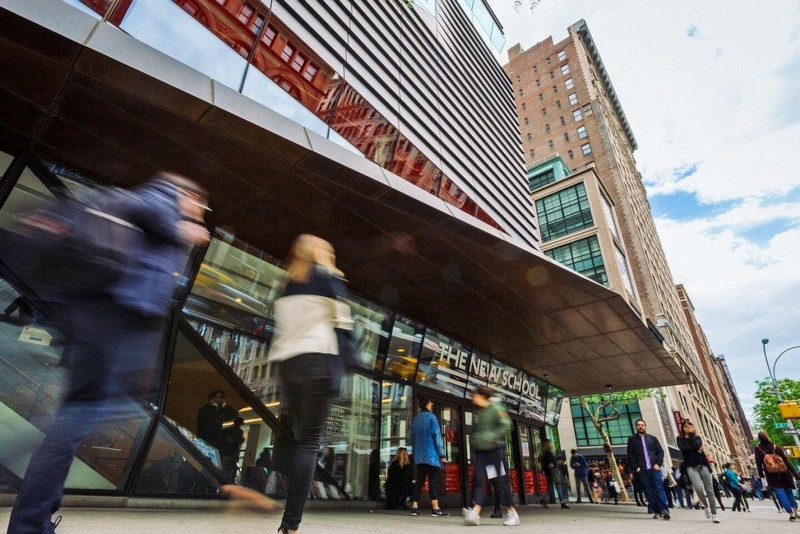
— Students walk on the campus of Parsons School of Design in New York City. Photo courtesy of The New School.

NEW YORK — For many Chinese students in art and creative fields, the question of studying abroad is increasingly shifting from where to apply to what happens after graduation.
Students in disciplines such as game design, visual communication, music, fashion, architecture and film have long viewed overseas art schools as important platforms for developing creative skills and gaining international exposure. But as global creative industries adjust to changing economic conditions, technological disruption and evolving employer expectations, career planning is becoming a more urgent concern earlier in the student journey.
The shift is especially visible among Chinese students studying in major creative hubs such as New York, Los Angeles and London. While many academic programs continue to emphasize personal expression, conceptual development and creative experimentation, students are increasingly aware that employers often look for a broader set of professional abilities, including project execution, teamwork, communication, commercial awareness and the capacity to deliver practical outcomes.
“Compared with when I first became involved in this field around 2020, more art and creative students today are thinking about their post-graduation plans at a much earlier stage, rather than focusing solely on which school to apply to,” said Leo Xiao, an industry observer at CM Career, which advises art and creative students on career development.
Xiao said the trend has become more apparent through recent work with Chinese students in creative programs in the United States and the United Kingdom, including Parsons School of Design students who have recently secured job offers after preparing for roles in design and related creative fields. He said such cases reflect a broader shift among students, who are increasingly looking beyond admissions and toward long-term career pathways.
At recent student exchange events, Chinese students from institutions including the University of Southern California, Parsons School of Design, New York University, Pratt Institute and the Fashion Institute of Technology raised similar concerns. Some students said they felt a gap between portfolio-based academic training and the practical skills required in professional settings. Others said they were uncertain about how to enter the industry, identify suitable roles or navigate job markets across different countries.
That uncertainty reflects broader changes in the creative economy.
The rapid development of artificial intelligence is reshaping workflows across design, filmmaking, digital content production and other creative sectors. Entry-level creative roles are also changing, with employers increasingly expecting young professionals to understand AI-assisted production, digital collaboration tools and the business context behind creative decisions.
As a result, market demand for creative talent is becoming more complex. A single artistic or technical skill may no longer be enough. Students who can move between creative, technical and commercial contexts — and translate ideas into professional outcomes — may be better positioned to adapt to industry change.
In China’s study-abroad market, support services have traditionally focused heavily on school selection, application strategy and portfolio preparation. Career support after graduation, especially for students in art and creative fields, has received comparatively less attention.
Each year, many Chinese students enter overseas creative programs, only to face a new set of questions after graduation: how to break into the industry, how to build relevant experience, how to communicate the value of their creative work to employers, and how to convert academic portfolios into job-ready professional narratives.
“When similar concerns repeatedly surface across different cities and institutions, they are no longer merely individual choices, but signals released by structural changes within the industry,” Xiao said.
He said the key challenge for future art and creative students is no longer only whether they can study abroad, but whether they can build resilient long-term career pathways amid shifting global conditions and industry cycles.
For many students, the challenge is increasingly to connect creative education with the realities of a changing labor market.
Contact Info:
Name: Mandy Yang
Email: Send Email
Organization: CM Career Limited
Website: https://xhslink.com/m/AaxSsLI4YkQ
Release ID: 89192463
If you detect any issues, problems, or errors in this press release content, kindly contact error@releasecontact.com to notify us (it is important to note that this email is the authorized channel for such matters, sending multiple emails to multiple addresses does not necessarily help expedite your request). We will respond and rectify the situation in the next 8 hours.
