

TampaBayMold.net releases homebuyer guide on professional mold inspections for Tampa Bay real estate transactions, addressing Florida’s disclosure laws, subtropical climate risks, and post-hurricane water intrusion threats following Hurricanes Ian and Helene.
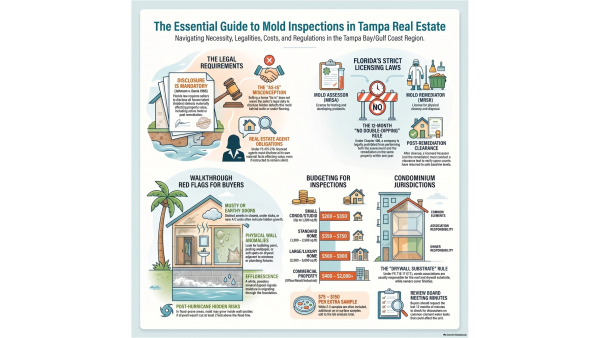
— TampaBayMold.net has released a homebuyer guide addressing the need for professional mold inspections in Tampa Bay real estate transactions, with particular emphasis on the region’s subtropical climate and heightened post-hurricane risks. The guide provides actionable guidance for navigating Florida’s disclosure laws and mold inspection requirements, directly responding to the area’s year-round humidity and water intrusion threats that followed Hurricanes Ian in 2022 and Helene in 2024. According to case studies from the Tampa Bay area, as many as 75% of inspected homes tested positive for mold following major storms, establishing the urgency for buyers to obtain independent assessments before closing on properties in flood-prone neighborhoods.
More details can be found at https://tampabaymold.net/learn/do-i-need-a-mold-inspection-before-buying-or-selling-a-home-in-tampa/
Florida’s climate creates foundational conditions that make mold inspections necessary for Tampa Bay homebuyers. With statewide relative humidity averaging 74% year-round according to independent climate data, the state consistently exceeds the 60% threshold at which mold begins to develop. Spores can colonize within 24 to 48 hours of moisture exposure. This environmental reality positions mold as a material health and structural defect rather than a cosmetic concern, particularly in properties that experienced water intrusion from roof leaks, plumbing failures, or storm surge.
Florida law mandates that sellers disclose all known mold and water damage as material defects under the landmark 1985 Florida Supreme Court ruling Johnson v. Davis, which shifted the state away from caveat emptor and placed disclosure duties squarely on sellers. A common misconception persists that selling a home under an “As-Is” contract negates these disclosure obligations, but Florida courts have consistently ruled that latent defects such as hidden mold must still be revealed in writing. The standard FAR/BAR contract used in most Tampa Bay transactions includes explicit yes-or-no questions regarding water intrusion and mold history. The optional Mold Inspection Rider (Form CR-6_I) allows buyers to dedicate a separate inspection period specifically for certified mold testing.
Florida Statute Chapter 468 establishes regulatory safeguards designed to protect consumers from conflicts of interest in the mold services industry. The law prohibits any company from performing both mold assessment and remediation on the same property within a 12-month period if visible mold exceeds 10 square feet. This ensures that inspection findings remain independent from financial incentives to recommend cleanup work. The state requires separate licenses for mold assessors (MRSA) and mold remediators (MRSR). Anyone performing services on areas larger than 10 square feet must hold active credentials issued by the Florida Department of Business and Professional Regulation.
Homebuyers in the Tampa market should budget between $350 and $600 for a standard residential mold inspection, with costs varying based on property size and the number of laboratory-analyzed air samples required. According to independent pricing research, small condos under 1,200 square feet typically fall in the $350 to $500 range, while average single-family homes between 1,200 and 2,500 square feet cost $500 to $750. Additional lab samples typically add $75 to $150 each. This upfront investment is minimal compared to the expense of post-purchase remediation or health-related claims that can arise from undisclosed mold colonization behind drywall or inside HVAC systems.
The guide covers both buyer and seller perspectives, detailing red flags to watch for during property walkthroughs such as musty odors, water staining, and soft spots in drywall. It also addresses HOA and condominium-specific mold issues governed by Florida Statute 718.111(11). The resource includes frequently asked questions about contract contingencies, seller repair obligations, and the role of thermal imaging and moisture meters in detecting hidden water intrusion. With over 17 years of industry experience and 12+ years serving Tampa Bay families, the company offers free consultations and quotes to help buyers and sellers navigate the complexities of mold assessment in Florida’s humid climate.
For more information, visit https://www.tampabaymold.net
Contact Info:
Name: David Koerner
Email: Send Email
Organization: TampaBayMold.net
Address: 550 N. Reo St. Suite #300, Tampa , FL 33609, United States
Website: https://www.tampabaymold.net
Source: PressCable
Release ID: 89200904
If you detect any issues, problems, or errors in this press release content, kindly contact error@releasecontact.com to notify us (it is important to note that this email is the authorized channel for such matters, sending multiple emails to multiple addresses does not necessarily help expedite your request). We will respond and rectify the situation in the next 8 hours.