
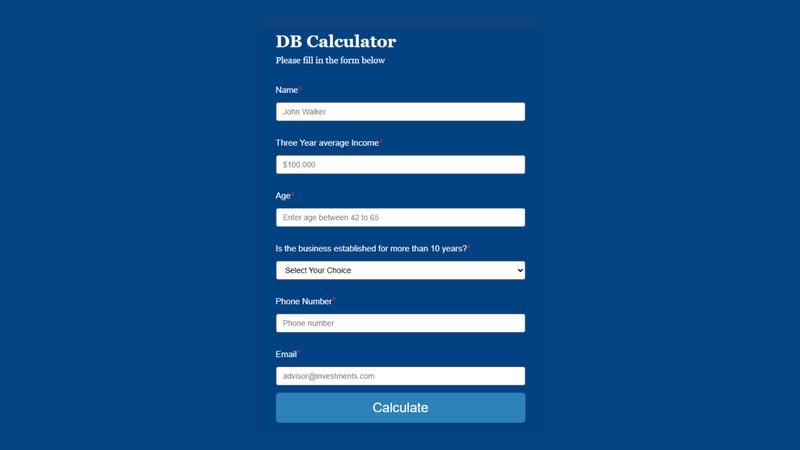
Pension Deductions features a Defined Benefit Plan Calculator, an online tool helping self-employed professionals and small business owners estimate retirement contributions. Using IRS-based assumptions on age and income, it provides early insight into defined benefit and cash balance planning strategies for smarter long-term retirement decisions.
— As more self-employed professionals and small business owners look for ways to increase retirement savings while managing tax exposure, Pension Deductions LLC is seeing heightened interest in its Defined Benefit Plan Calculator, an online tool designed to help business owners estimate potential annual contributions available through defined benefit and cash balance retirement plans. The calculator is intended to provide early-stage insight into advanced retirement strategies that are often overlooked due to their perceived complexity.

Defined benefit and cash balance plans differ from traditional defined contribution plans by allowing retirement benefits to be structured as a targeted income stream at retirement. Under Internal Revenue Service rules, a defined benefit plan may be designed to provide up to 100 percent of a participant’s highest three year average compensation as annual retirement income, subject to applicable limits and actuarial assumptions. As benefits are defined first, contribution amounts are calculated backward based on age, compensation, and the assumed retirement age, typically 62 or 65.
It is common for these plans to allow the plan sponsors to contribute amounts as high as $300,000 to $500,000 each year. Moreover, contributions are flexible and the plan sponsor can choose to contribute any amount within the actuarially calculated range. The actuarial range can be further adjusted with the plan being amended at appropriate times.
A Practical Example of Plan Design
To illustrate how this structure works, consider a self-employed business owner operating through an S corporation who receives $100,000 in W-2 compensation, with additional business income flowing through separately. Using this compensation level, a defined benefit plan may be designed to provide $100,000 per year in retirement income beginning at an assumed retirement age of 62.
In determining how much must be accumulated to support that income, the IRS requires actuaries to apply prescribed mortality tables to estimate life expectancy. In this example, the applicable table projects a lifespan to age 82, meaning the plan must be funded to support 20 years of retirement payments.
Ignoring interest rate assumptions for simplicity, supporting annual withdrawals of $100,000 over that period would require approximately $2 million at retirement. This amount represents the lump-sum equivalent of the defined benefit. If the business owner is currently 52 years old, there are ten years between now and the assumed retirement age. To reach the $2 million target over that time frame, the plan would require annual contributions of roughly $200,000.
Applying the Framework Through Online Calculators
This same actuarial framework underpins the defined benefit and cash balance plan calculators developed by Pension Deductions. By entering just two variables — age and compensation — users receive estimates based on IRS-prescribed interest rate guidance and mortality assumptions.
“These calculators do not replace a formal plan design, but they serve as an important first step,” said Shrideep Murthy, CFA, principal at Pension Deductions.
Next Steps in Establishing a Defined Benefit Plan
The first step in establishing a defined benefit plan is determining how much a business owner can realistically contribute. Unlike 401(k) and profit-sharing plans, which rely on fixed annual limits, defined benefit plan contributions are highly individualized and depend on several variables, including age, compensation, business structure, and the targeted retirement benefit. As a result, two business owners with similar income levels may have materially different allowable contribution ranges.
After reviewing an estimated contribution range, business owners typically collaborate with their CPA to evaluate whether sufficient cash flow exists to support the proposed funding level on an ongoing basis. This step is critical, as defined benefit plans are subject to minimum funding requirements, and contributions generally must be made each year once the plan is established, unless the plan is amended to reduce the required contributions. Evaluating income stability, projected profitability, and tax considerations helps ensure the plan is both sustainable and aligned with broader financial goals.
Once the contribution level has been agreed upon, an actuary prepares the formal plan document in accordance with IRS and ERISA requirements. This process requires specific business information, including the legal name of the company, employer identification number (EIN), business address, ownership details, and employee census data where applicable. The plan document establishes the benefit formula, eligibility rules, and funding assumptions that govern the plan.
After the plan is adopted, an investment account must be opened through a financial advisor or brokerage firm to hold plan assets. These accounts must be established as qualified retirement accounts so that investment earnings grow on a tax-deferred basis. In addition to ongoing funding, defined benefit plans are required to file annual actuarial returns with the IRS, separate from business and personal tax filings. These filings must be prepared and certified by an actuary, underscoring the importance of specialized expertise in administering these plans.
Plan Termination Considerations
A defined benefit plan may be terminated by the plan sponsor at almost any time, including situations where the plan becomes fully funded, business profitability declines, or the business owner no longer wishes to maintain the plan. Upon termination, plan assets are distributed to participants and can generally be rolled over into an individual retirement account (IRA) or another qualified retirement plan. When handled properly, these rollovers are not taxable events and allow retirement savings to continue growing on a tax-deferred basis. The termination process must comply with IRS and ERISA requirements and typically involves actuarial certification and formal filings to ensure all benefits are fully satisfied.
About Pension Deductions LLC
Pension Deductions LLC is a retirement plan consulting firm focused on helping self-employed professionals and small business owners evaluate and implement tax-efficient retirement strategies. The firm specializes in defined benefit and cash balance plan design, analysis, and ongoing support, working closely with business owners, CPAs, and financial advisors to navigate complex regulatory and funding requirements.
By combining actuarial insight with practical planning tools, Pension Deductions helps clients better understand contribution potential, compliance obligations, and long-term retirement outcomes. For additional information or assistance, business owners may contact Pension Deductions at info@pensiondeductions.com or visit www.pensiondeductions.com
Contact Info:
Name: Pension Deductions Team
Email: Send Email
Organization: Pension Deductions LLC
Address: Stamford, CT 06905, USA
Website: http://pensiondeductions.com
Release ID: 89182523
If you detect any issues, problems, or errors in this press release content, kindly contact error@releasecontact.com to notify us (it is important to note that this email is the authorized channel for such matters, sending multiple emails to multiple addresses does not necessarily help expedite your request). We will respond and rectify the situation in the next 8 hours.
