

The $7M round, led by Khosla Ventures, will enable Mara to build Spike, an automated counter-UAS system designed for the small, inexpensive FPV drones reshaping modern conflict.
San Francisco, CA, Aug. 26, 2026 (GLOBE NEWSWIRE) — The deadliest weapon in modern warfare, the small and ubiquitous FPV drone, costs a few hundred dollars and can disable a vehicle worth millions or knock out power for millions of people. Yet much of the counter-drone (counter-UAS) industry was built for a different target: large drones flying high overhead on a predictable course.
Small FPV drones launch from anywhere, attack in groups from several angles at once and increasingly use fiber-optic control links or onboard guidance to bypass traditional electronic jamming. Despite billions in counter-drone investment, these drones remain the leading cause of combat casualties globally. After Ukraine’s Operation Spiderweb in June 2025, the world realized that FPV drones can destroy strategic and civilian targets thousands of kilometers from active combat.
Mara was founded to neutralize this threat. Today, the company announced a $7 million funding round to bring Spike, its integrated counter-UAS platform, from field testing to broad combat deployment. The round was led by Khosla Ventures, with participation from a16z Speedrun, Night Capital, Palmdrive, Protagonist, Freedom Fund and Indicator Fund, alongside angel investors.

Mara founders Sriram Raghu and Daniel Kofman.
Why this matters now
FPV’s use pincer, swarm, and ambush tactics to circumvent defenses.
Traditional counter-UAS systems rely on a gun, laser, or semi-piloted interceptor focused on one sensor and effector cone. That can work against larger high-flying threats, or against one FPV drone at a time. It stops working when several small drones arrive along different vectors in rapid succession. Over the Ukrainian front line’s infamous “gray zone”, hundreds of FPVs are in the air per square kilometer doing just that.
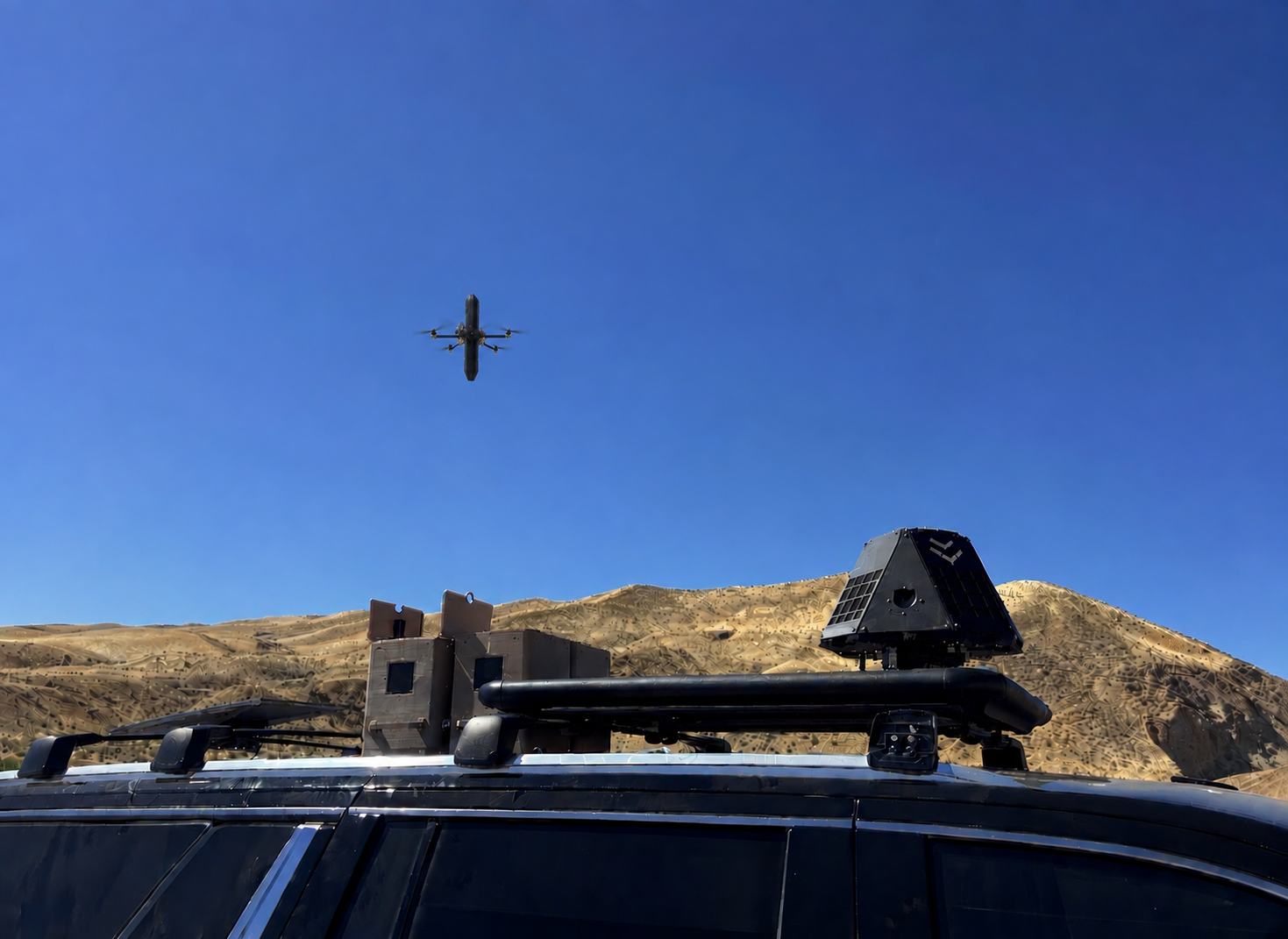
Spike by Mara. An integrated counter-sUAS system.
Mara’s answer is distributed, autonomous, omnidirectional defense. “Small drones changed the battlefield because they distributed the cost and capability of precise attack,” said Daniel Kofman, Co-Founder and CEO of Mara. “Most defenses still concentrate both replacement cost and line of fire. Spike instead creates a distributed mesh of small, cheap nodes that can each aim and shoot in multiple directions at once.”
Spike uses stationary targeting sensors alongside a magazine of tiny interceptors, giving the system 360-degree hemispherical coverage in a portable package. Designed to be fully attritable from the sensors to the interceptors, Spike can fire on dozens of threats simultaneously at a system cost below the cost of the asset being protected.
How Spike works
Spike combines the full counter-UAS chain in one system consisting of two modular parts that work alone or together.
Its Spotter targeting system combines visual, acoustic, and optional radar sensors with advanced in-house AI for day, night and all-weather detection. Its Seeker kinetic interceptor is small (250g), fast (200kmh), and tube-launched, with onboard intelligence. Spike can pass launch orders autonomously from Spotter to Seeker, but a human remains on the loop to set rules of engagement and safely abort launches if necessary.
Spike is designed to scale with the mission. A rucksack-portable configuration can protect a dismounted squad. Vehicle-mounted Spikes can cover a convoy. Larger deployments can create multi-kilometer perimeters at military bases, front lines, sporting events, or power plants.
From dorm-room prototypes to field use
Mara was founded in October 2024 by Daniel Kofman and Sriram Raghu, who met in high school in 2013 and have been building together ever since.
Their work in drones began with tactical FPV prototypes for a DHS program, assembled from their college dorm rooms. The pair later co-founded, alongside its current CEO, Optivolt, which shipped smart solar panels to Anduril, the U.S. Air Force and Ukraine. Mara grew from their conviction that the industry had left the most important and lethal defense gap wide open.
Over the past several months, Spike’s components have moved into live field exercises. Seeker completed intercepts cued through U.S. Army software at an exercise in Texas. Spotter operated hands-free on an armored vehicle during another Army exercise in Europe, feeding detection data into Army command software. Mara demonstrated end-to-end engagement in field testing with a U.S. special operations unit, where Spotter detected the target and cued Seeker to launch without operator input.
Most recently, in July, Ukrainian forces operated Spotter 40km from the front line, where it tracked multiple FPV drones.
Beyond military applications, Mara is deploying Spike in a civilian pilot at a South Korean port. The company has cooperative research and testing agreements with three U.S. defense organizations, was selected for NATO’s DIANA innovation accelerator and is in early-stage engagement with international military partners in the UK, Czech Republic, and Ukraine.
“Mara has moved rapidly from proof-of-concept to user testing for an autonomous system,” said Nicole Fraenkel, Partner at Khosla Ventures. “what caught my eye is that they’re building counter-drone autonomy with a system cost that’s orders of magnitude lower than anything else we’ve seen.”
What’s next
Mara is currently focused on deploying Spike to key customers for ground-mounted use by the end of 2026. Vehicle-mounted and man-portable capabilities will launch alongside production scale-up in 2027.
Once Spike is deployed at scale, Mara plans to continue its mission – using machine autonomy to defend human autonomy – by mass-producing an arsenal of cheap, tiny robots that dominate the line of contact in any battle: land, air, or sea.
Media images can be found here.
About Mara
Mara (https://mara.inc/) is a defence hardware startup. Its customers include military and government organizations, as well as commercial clients, who need to protect people, equipment, and infrastructure from small drone swarms. Deployment scales from a single rucksack kit protecting a squad, to a vehicle-mounted loadout, up to a multi-kilometer perimeter “fence” for a base or brigade frontage.
Mara’s key product is Spike, an integrated counter-sUAS system, made up of two elements:
- Spotter — a persistent detection and tracking sensor combining electro-optical, acoustic, and an optional low-signature radar, giving day/night, all-weather coverage.
- Seeker — a small, fast, and tube-launched autonomous interceptor drone that identifies and closes on a target without a human pilot, inexpensive enough to be used and lost freely.
CONTACT: For further information please contact the Mara press office on media@mara.inc
